
.png)
Clinical pharmacy specialists share how prescription drug monitoring programs serve as essential tools for responsible opioid prescribing.

Below is the full transcript of The Next Orbit podcast Episode 1: The Future of Opioid Stewardship: Data, Technology & Compassion in Care
This episode is part of The Next Orbit podcast's ongoing exploration of how connected data transforms healthcare delivery. From prescription monitoring to public health surveillance, we're spotlighting the innovators building smarter, more integrated systems.
Have questions about PDMP integration or state-level data exchange? Connect with our team.
Subscribe to The Next Orbit podcast for more conversations at the intersection of healthcare data, technology, and policy.
Welcome to the Next Orbit podcast, where connecting healthcare's data is the next frontier. We take you inside conversations with policymakers, healthcare leaders, disruptors, and visionaries who are pushing boundaries in a system that resists change. Explore how modern technology can remove barriers and improve care at scale. It's about ditching inertia and building smarter. For insiders, innovators, and anyone ready to navigate what's next, this is your Launchpad. Here is your host, Ben Wade.
Hi, and welcome to the Next Orbit podcast. I am your host, and today I'm thrilled to be joined by two pharmacy trailblazers. My first guest, a 15-year veteran as a clinical pharmacy specialist and practitioner with an acute focus on opioid stewardship and managing complex pain syndromes. In 2023, she made history by becoming the first clinical pharmacy practitioner in her state to obtain a DEA license, allowing her to manage opioid use disorders independently. My second guest, also a doctor of pharmacy, pioneered an opioid stewardship program that slashed opioid use by 50% in internal medicine. He's also a prolific content creator on LinkedIn sharing clinical pearls and insights on pain management. With that, I'd like to welcome Shelley and Sing Ping to the show. Thank you for being here.
Thank you. Thank you for having us.
So, today we're going to talk about prescription drug monitoring programs. Just to give the listeners a brief background on what is a prescription drug monitoring program. It's a state-run electronic database that collects and tracks prescription data typically reserved for controlled substances, but some states do track all medications. They're not anything new. So the first or the longest running prescription drug monitoring program goes to California. It was started in 1939 and as you can imagine it was a much more paper-driven process back then. But the idea is not new. We've just seen a greater adoption over the last decade as a result of the opioid epidemic. What is an opioid steward or a steward of opioids?
That's a really good question, Ben. So the way that I like to think about opioid stewardship is think about whether or not we are using the opioid wisely and appropriately, right? Because in a lot of cases just because we see that an opioid is being prescribed, I always have to ask myself and my trainee is that are we using it appropriately? Meaning that is the indication correct? Is the duration appropriate? I mean there is a lot of gray area involved, right? No doubt that there is a lot of gray area involved when it comes to opiate prescribing but then when we think more about the appropriateness for example does the patient have any kind of underlying psychiatric conditions that we need to be concerned that maybe we need to dose it a little bit more wisely and appropriately and those are the cases where a pharmacist especially like a pain specialist can really have a big role and that is really how I think about opioid stewardship.
Yes. And I would agree with Sing Ping. It's very synonymous with antibiotic stewardship. So some people are well aware of using the right antibiotic for the right bacteria for the right amount of time. So it's the same thing for opioid stewardship, which does not mean that nobody should get opioids. And that's maybe a misconception. There is still appropriate use of these higher risk opioids. So we help with those decisions, evaluating risk like Sing Ping said with mental health background, maybe respiratory conditions that might contribute to a potential respiratory event. And it's across settings. So it can be inpatient like Sing Ping is mainly inpatient with opioid stewardship. I've been involved in both inpatient and outpatient but not everybody may be able to do that wide of a stretch.
Appreciate that explanation. I think it's a common misconception that being an opioid steward or a steward of opioid prescribing means that you're attempting to slash or cut out opioids at all cost when it sounds like it's more of making sure that you're prescribing responsibly and doing all the things that you can to prevent overuse or misuse of controlled substances. So, what role does the PDMP play, the prescription drug monitoring program? What role does that play in your day-to-day lives as clinicians and as stewards of the opioid crisis?
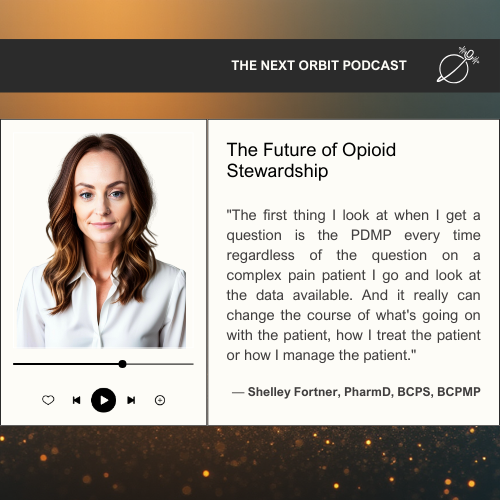
Excellent question. Undoubtedly, it's at the forefront of what I do and working up every case. I've been doing clinical pharmacy pain management for pretty much the entire time that my state has had access to that information. And so, I've evolved with it and grown with it. Expansion and communication between states which may come up a little bit later, so I'm working in a health system where it is integrated and we do get information from multiple states on a patient and it's pretty, it's very easy to access. An example would be that it's just ingrained in my DNA now that the first thing I look when I get a question is the PDMP every time regardless of the question on a complex pain patient I go and look at the data available. And it really can change the course of what's going on with the patient, how I treat the patient or how I manage the patient. But it's often not, it's not always done even in a system that has this all very integrated and what we would call an easy button to make it where they don't have to jump out of the system and sign in. I had a case today that the patient was saying that he was on a medication, specifically oxycodone and said 40 milligrams a day. Well, the team, great for them, they went and looked at the PDMP and it showed nothing. And so they went back to the patient and posed it and he said that he, he's like, I told you I obtained it privately and that was it. And it was posed to me as patient says he's getting, he uses this, it's not on PDMP, having a hard time managing pain and what had happened was the patient was using, he had an illicit source that he wasn't being forthcoming about and that really changed like the doses they were giving him weren't even coming close to what his usual daily dose was for years. And it doesn't take a pain specialist to just ask the question. It's a medication reconciliation or a drug, however you want to say it, a drug reconciliation that as pharmacists we do all the time. Every encounter we're asking if there's any changes. Are you taking anything new or how can I, I don't see anything on the PDMP. Is there anything I should know about and to better take care of you and that's really how you pose it where I think he initially thought he was going to get in trouble from what he was saying, but this isn't coming from a punitive standpoint. It's a safety standpoint and providing the care that he needs. So it really was an avenue for myself and my trainee to work with him and take over the management of all things opioid for him and so it made a big difference.
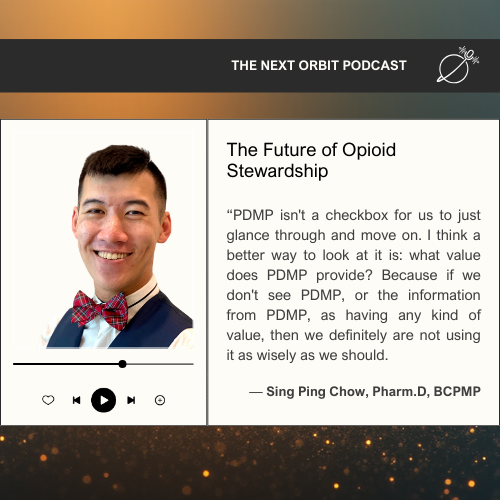
So every day you've hit a lot of high points when it comes to evaluating PDMP and I really agree with everything you said there and one of the thing that when I remind myself why do I do PDMP and really is doing PDMP isn't a step like it isn't a checkbox for us to just check the box or maybe just glance through it and then move on. I think a better way to look at it is and which isn't really taught in school is that what value does PDMP provide right because if we don't see PDMP or the information from PDMP as having any kind of value then we definitely are not using it as wisely as we should. But then if we break it down into like the granular level like what Shelley was doing earlier is you take a look at whether or not the patient has any kind of control substance fill history, right? Because the first thing that the PDMP will allow us to do is you have a snapshot of what the patient is filling in the past two years. I think two years is slightly the cut off. And then the other thing that it really allows you to see is what are the changes in terms of the dosing over time because when you go into the room and talk to a patient, let it be inpatient or outpatient, you want to build rapport as fast as you can. And one of the thing that you can really build rapport with the patient is do your homework. And so if you see any kind of changes in terms of dosing or any kind of new medication on PDMP, that's a good conversation starter instead of going in there almost like blindsided and not knowing what's going on. And so with PDMP, that gives you a leg up and serves as a conversation starter. And the other thing like Shelley was saying is that it allows you to perform not just from the dosing standpoint right because in terms of the opioid safety and how we can really help with the opioid crisis is that if we see any kind of pattern of for example doctor shopping or patient go to different pharmacies and of course now with pharmacy closing down and that's another kind of noise right so we have to be very careful interpreting what does it mean to be doctor shopping what does it mean to be changing pharmacy and I think those are all the good information that PDMP is feeding us so it really the core question is are we realizing those are actually the gold like the PDMP, the government or you guys, spent a lot of money and resources into this program. So, I think really like how are we utilizing this program and are we really using it to the maximum capacity? So, that's how I see PDMP and the value of that.
Sing, what's your experience been in terms of are physicians using the PDMP in the same way that you're using it as a pharmacist? We know that all 50 states now have access to some flavor of a prescription drug monitoring program. So theoretically everybody should have access to use these tools in the same way and get the same use cases out of them. Are you seeing that providers and physicians in different health settings are using it to this capacity or is it being used as a checks and balances system when prescribing narcotics only?
I think that's such a good question because I think it really ties to different almost like the shortcomings in terms of our current practice right and I would say I see like a mix 50/50. Shelley definitely share your point of view after what I'm sharing because we do want to hear through different settings what are we really seeing but for me if say for example for like physicians who have been practicing for some time, they have more experience in terms of interpreting or even having that as a habit, right? Because having reviewing PDMP as a habit versus even not reviewing it as part of the habit, that makes a huge difference. I would say that with physicians like who are new grads or residents and those are like the group that has a bit of a learning curve because some of the thing that we almost like we're not acknowledging as well as we should is that and I can speak for myself is that back in pharmacy school or even when I was doing rotations so basically kind of the on-site apprenticeship. And so even in those times when it comes to reviewing PDMP like the knowledge or the teaching that I receive isn't necessarily the most robust and I'm not saying that it's anything bad but if you ask around right if we ask around different physicians from different area let it be pharmacist or PA or physicians then it seems to be like there is a lack of education when it comes to pain management and specifically pain medication management, right? Because we hear pain medication or pain management a lot, right? We know the general concept use the minimum effective dose and be mindful of the interaction know that it's a very risky medication and pretty much that's that. The in-depth education of PDMP sometimes is lacking and even for my training when I'm training like residents or new practitioners I tend to see that that is something that's lacking the in-depth interpretation the knowledge of how to utilize it like you said is lacking. So that's what I see and I was wondering if Shelley has a different viewpoint or it's something similar.
Absolutely. Something similar to Sing Ping. The issues that we face are similar but specific to our work settings. I agree that new providers, new graduates have no idea. And so catching them to explain hey this should not be just a knee-jerk thing because we have to if we're giving them a prescription. It should be part of your workup like an assessment of any patient not just a pain because it does controlled substances benzodiazepines stimulants some seizure medications are controlled medications so for my state we don't have the we only have the prescription controlled substances that get reported if I had everybody's drug report like maybe some state does I think that would probably be information overload for me but just coming from how I operate but standardization across providers even within a health setting that has been doing this for since I've graduated residency so over 10 years there's just it's all over the place and so that's a struggle and it's just you can't avoid helping you have to educate so that they can stay up with the times and know that it's a tool in their toolbox.
So, it sounds like education is one piece or a lack thereof in some cases, but I think there's also other challenges that you may not experience being part of a large health system like you are. Things I hear from other physicians and providers that I talk to maybe in smaller medical groups or independent practices is I would say a lack of interoperability. So, a lot of PDMPs there's varying levels of connectivity. Some states don't allow for any interstate data queries. Other states have numbers as high as 48 and everything in between. So, I think that's one thing is especially for states that are bordered and have patients that are crossing state lines, having interstate data available is one challenge that providers experience that you may not. Another is really just integration within the EHR system. So I think Sing Ping and Shelley, you both have one-click integration available where you're in a patient's chart in your pharmacy system and you can one-click access their PDMP record. So some providers in smaller health systems don't have that one-click access. And what that looks like is administrative burden. These providers are already operating at maximum. And so when you have to go into the state PDMP through another website, remember your login credentials or hopefully remember them and then do a patient search, making sure that you are on the right patient, viewing the right record. Those are all things that take time and often time in these smaller systems or the providers that don't have that direct access, they're delegating that responsibility out from what I've seen to another member of the clinical team. And I think that that can often times remove the physician or the provider from having that kind of direct ability to look and having a conversation with the patient based on something they may see in the record.
Totally agree. I've been, when we first got it, it was a manual query. I'm a border state line. So, I needed the neighboring state's data and we had access to both. And then we had, I'm in a federal system, so that reporting wasn't immediately available to states because of privacy concerns for military and veterans. Now it has, but back then I was doing these manual queries. I can absolutely relate to the typing your password in 99 times in a day and then documenting that you're doing it because you're told if you query it, you got to document and it just moves and even having a surrogate moves away like you said from the clinical decision being with the person that's ultimately responsible. So yeah, if you have a surrogate that may seem to help your time, but you still are ultimately responsible for what that surrogate has put in that note and if you haven't laid your eyes on it, then you better be confident in the person that is your surrogate. So that just still goes back to if you're in that setting, it's not, trying to reframe it as not a burden. It's a tool that is needed to provide necessary care for people who do technically have to query it to order a prescription because of state laws usually say if it's a controlled substance at a new prescription or a dose change of the higher C2s you would need a new PDMP and so it's a tool and again education and empathy because we've been there I've been there and it's not fun resetting your password four times in a week because I've done it and if our system's down we have to log in manually and Lord knows I haven't remembered my password from six months ago when it was last down and so I have to reset it and it's gotten easier because it'll now text you but at least in our state so when things like that happen the line starts getting longer at the pharmacy patients start to stack up in the waiting room and can be stressful so yeah I think having that integration certainly would certainly help providers be enabled to take a longer glance at their medication, both his historical and current meds, and at least help start a conversation with the patient about anything alarming they may see.
In your organization, you're able to query multiple states to get data back. I know that we talked about that. Have y'all experienced any challenges with patient matching or patient identification, making sure that you're in the right patient's record? And yeah, have you experienced any challenges like that?
I actually now that you bring that up, I have a case actually this week that on the PDMP, it says that the patient has been filling benzodiazepine for a few months. And so when I asked the patient about doing like the medication reconciliation and see whether or not I should resume that medication and the patient said no like the patient is not taking any benzodiazepine for a long time and it was like a long history. So when I go back and take a second look at the PDMP, it's funny because when the patient have very similar last name, I guess it's almost like a syntax error. Then they would pull very similar patient who have like the same birthday, very similar last name, but their address is completely different, right? So the wrong entry, that patient is living in some other state and so that can happen and so again it takes really a lot of attention to kind of piece together what you're seeing and I would say before you try to confront the patient so to speak right you want to make sure that you lead with empathy and really don't assume and jump to conclusion because things like this happen and it's really not the patient's fault and is the technological problem here.
Same. It's been, we've grown and it's gotten better, but there's specific privacy stuff that it's not like a identifiable. It's not your social security number that they're linking. So, common last names and birthdays. It will in our on our side for where I'm at, you see that, hey, there's multiple patients that may not all be the exact and it's at the top of the query. So, that can alert you, but you got to read it. You can't then just like just click it and then click out. And then withholding a medication or starting a medication that they're not on has been an issue in my experience. And I only spent a lot of time on one where I worked really hard to have that patient's profile separated from someone that had the same first name, same last name, same birthday and was in a completely different part of the country. And it was tough. And I had to hand off to some people that work in our system with PDMP and not everybody has that opportunity. So, again, back to like you got to be careful. You got to look at it and there are it's technology and technology is not perfect. I will die on that hill that technology is not perfect.
I think that's an area that as a whole can be improved upon. And what I've seen is it really depends on where you are, both the state that you're working in and the organization that you're working for or are employed by. So for example, some states, their PDMP is connected to a health information exchange. And so what I've seen in those scenarios are there's a master patient index on the back end. They're being fed data from multiple sources. So they have more to use to aggregate and make sure that you have the correct patient, whereas some states are not. And you're really just basing it off of identifiers that you're trying to match up. Your name, first name, last name, date of birth, which can be shared. I've seen situations where a nickname or a shortened name were used and that skewed the results. We'll get to the future of what we want PDMPs to look like and act like here in a minute, but I think it's important that we also look at integration with national health data exchanges and common frameworks using eHealth Exchange, Care Quality, CareAnywhere as tools to help enrich the data and make sure that we've got good patient matching on the back end to take or alleviate some of the work that clinicians are having to do to get meaningful use out of the platform.
So, Sing Ping and Shelley, what are some of the other challenges that you experience when using and evaluating the prescription drug monitoring program? What are some things that may be sticking points for other physicians, members of the clinical team or pharmacists from getting meaningful use out of this or being able to properly do their due diligence in a timely manner?
I'm gonna start first. And I know it's gonna sound silly if I call it out, but time is money. Right now, with our current system, it still takes right around 30 seconds from the time you click what we call the PDMP button to the actual time of having it loaded, right around that time. So I would say that I don't mind the 30 seconds but I want the time to load the data to be as short as possible. So then we don't even hear the excuse of maybe the PDMP button is taking too long for it to load and it discourage physicians from using it. So if in the most idealistic scenario is we can shorten the time from 1 to two seconds, you click it, it pops up, I can see the thing, that would be perfect, but I know it's going to be a work in progress. It's never going to be that perfect. So I know it's silly to say that.
Well, I don't think it's silly at all. But I think if you were to poll all the providers, 99% of them would tell you that 30 seconds is a lifetime when you're sitting there in front of a patient or waiting to get on to the next one. So certainly don't think that's an odd call out and something that could be improved upon. Shelley, what are your thoughts?
Well, Sing Ping's living on Mars and I don't know that that could happen, but it would be lovely to be more efficient in the process as someone who does have that issue when I'm going to order the prescription because it's a requirement. So, I have to do that note at that time to then go on to process to order a controlled substance. So, I can't skip it and it's going to take the time it's going to take and it does feel like a lifetime when someone's looking at you basically the patient right in front of me. The other thing if we lived, are still living on Mars and had it in a perfect world would be maybe if it was felt more like real-time data. Right now, at least locally, I still tell people that it may be days before a prescription that was filled would show up on our state's database. It probably has gotten quicker. I used to say seven days and I do believe it did used to take that long for it to get all onto the query but the lack of real-time data has kind of bit me in the butt before where I'm prescribing a patient who previously had a different prescriber. I've taken over, they're not supposed to go to any other providers. They know that and at that time when I'm ordering the medication it looks like everything it's just me lately and we're going to go on this process and then not two day well when I see them next time I do a query and it shows that actually the drug the same drug was filled the day prior so I didn't have that data and I was basically a duplication and at risk of issue when we're dealing with high-risk medications certainly an onus on the patient, they are with it enough to know that they did something wrong. But if we had a tool that we felt more confident that we had that actual day of data would be great. And if it was within the last hour, I would think that we're living on Mars. But it would be great.
Yeah, that's a great point. And clinicians, physicians, pharmacists aren't mind readers and so they can only make decisions based on the best data that they have in front of them at the time. So agree with you that real time data in the clinical setting is a key factor and something that we need to strive to improve. I think some states are probably better equipped to do that. But as we look into the future, I have a magic wand. I can fix everything. I think let's hear it. I think really what I see in the future of PDMPs are national interoperability like we called out seamless sharing of data across all 50 states integration with those national health exchanges to help aggregate better data and patient matching real time data like you mentioned making sure that what I'm seeing is the most up-to-date by the minute data on that patient seamless EHR integration. So not just for the big shops but for every provider being able to have that one-click access patient centric search where your patient is already coming up based on the chart that you're in incorporating that data into the existing workflows of the physician. So during your medication reconciliation, having that data available so you can do those checks and any prescribing that you might do in that visit will be able to take advantage of any drug-drug interaction checks that may be available. Getting into that more like predictive analytics, clinical decision support. What tools can we provide within the integration to allow the physician to check or catch things before they go out the door that may be an issue and provide therapeutic alternatives to that drug. And then really something I'd like to see in the future is patient empowerment. Why are clinicians and pharmacists the only ones who are allowed to see the PDMP data? I think making that available to patients whether it be through the portal or through a report that you provide in their record. I think that builds trust and transparency and alleviates a lot of questions that patients may have about why they may or may not receive certain medications or why these conversations are being had with them by their clinicians and pharmacists.
Having patients to be able to access to their own PDMP is important because Shelley and I were just literally talking about how there are mix up of patient record, right? And so, and the unfortunate fact is, what we see is all there is. And so when we see that there is something there that's not matching then sometimes we, a lot of us we will start to question and instead of jumping into the mindset of questioning or have any kind of doubts I think it will like you said we will be very transparent from the patient perspective and it's almost like it's part of their health record right so if they have access to just the chart or the labs, I know this might be something that they should also have access to. So then for any dispute like any kind of record mixup like we were talking about, then the patient will be probably be the best person to call that out and resolve any kind of conflict before that even happens and they can advocate for themselves.
So good and it goes back to how Sing Ping and I operate is in a patient centered model of letting the patient collaborate. It's not a dictatorship working with them in this tough field of pain management. Now we are in just one of the specialties that is involved in controlled substances but I think using the term empowering patients is excellent and they know themselves the best. They can prove that they didn't live somewhere if there's an address discrepancy and it would be I think that's an efficient way to solve some of the issues that may not be able to be fixed by everything that you are trying to obtain. So I appreciate your efforts and it's amazing what it could be in the next 10 years. You know it's evolved so much since I started so I'm excited to see how it's utilized going forward.
Well, Shelley and Sing Ping, thank you for all the insights you've provided. Both have a wealth of information and kind of a unique perspective on PDMPs. My favorite part of the show, I'd like to jump into getting to know you both a little bit better on a personal level. You don't have to overshare, but I'd just like to pose the question of what got you into pharmacy? Is it something that you wanted to be ever since you were young children or is this something that became a passion along the way?
I'll start. My desire to become a pharmacist did not start at the wee ages of when I was first asked what do you want to be? My answer to that question was I wanted to grow up and be Bob Vila. And so obviously that dates me back to the generation if anybody knew who Bob Vila was and that is the answer that my parents sent me to school to hang up on the school chalkboard but I don't come from a background of medical providers in my family. I had a lovely adviser in college and he said you're on the track to you could do this and I was like I have the credits to apply to pharmacy school. Okay. And I am just blessed to be in a position where I'm making a difference and doing the highest of clinical things that a clinical pharmacist can do. Specifically pain management was related to a very good rotation that I had on my clinicals, one the second rotation of my clinical year so final year of pharmacy school and the impact that it had on me and it was a pain management and palliative care so hospice-like rotation and I ended up becoming the preceptor for that same experience for others and so I really was dedicated to teaching and then I'm involved in our residency that I did and Sing Ping was one of our residents that we trained and he's flourishing. So, it's not an exciting story, but it's different than becoming Bob Vila. So, that's all I got.
What's your origin story, Sing Ping?
Oh, a little bit of confession. I don't have a glamorous, I grew up wanting to be a pharmacist story either. Not that my dad is a doctor, my mom is a PhD. No, I don't have that. So when I finished at the time, I was really kind of thinking about what kind of career can I pursue? At the time, I had like a biochemistry degree and really I wasn't quite ready for any kind of career at the point. I was immature at the time and so at that time I know that okay maybe I wanted to do medical field and I knew at the time I was too nervous to apply for medical school and I know I didn't at the time okay at the time I didn't want to have touching patients and I think that's for the most part that's the reason why people don't want to do nursing because you have to do a lot of like touching and managing patients on the very very frontline perspective. So at the time I didn't have dentistry in my back pocket. I didn't have ophthalmology whatever at the time I only knew pharmacy medicine and nursing. So I was like guess what I'm just going to do pharmacy at the time. So, I didn't really know what pharmacy really was until the second semester. I hate to say it because I didn't even work at a pharmacy even before enrolling in pharmacy school and I discovered what pharmacy was at the time. So if anyone is hearing this podcast thinking you want to do pharmacy just take a rotation work at work at a retail store before or ask someone who is a pharmacist or DM us or whatever just ask us or get a good idea what pharmacy really is and then so I become a pharmacist I graduated and at the time I didn't know after I finished the first year of residency, I was again kind of thinking about what I want to do next. And so, one of my mentor her name is Laura and she was like, "Hey, Sing, why don't you check out pain management?" Because she was my preceptor in a geriatric rotation and she said, "You have that kind of people skill to do that." So, I was like, "Okay." So at the time I didn't really know what pain management really was. But after I started the residency with Shelley and my good mentor Scott and then that really changed my trajectory because at the time I thought okay pain management back in the first year residency I knew how to manage opioid but I didn't realize oh there's a next level of thing called pain management and all that you do is not some superficial level of opioid management. It's a deep dive and there is almost like a emotional intelligence requirement for that because you have to navigate all that emotion and suffering with the patients and really after I discover that pain management requires a lot of problem solving a lot of people skill that really got me hooked and so now I've been a pain pharmacist for three years now. So that's kind of how I started becoming a pain pharmacist. It's not a glamour story, but then it clicked and then I'm loving what I do now.
You know, just like Bob Ross that it's okay to have happy accidents, right? And find things along the way. Definitely. No, I'm just curious also when you specialize in pain pharmacy, pain management, do they give you any training on how to communicate with patients or is that just something you have to hone your skills at as you go along?
I think it's been both. I couldn't have had better mentors in my career that started when Sing Ping was a baby. So in my residency years which residency for pharmacists is not required. If you want to work in a clinical setting managing patients it is the route to do that is typically through a residency but by no means do you have to do it. People get hired from pharmacy school into clinical positions but we were residents alongside medical residents and I had my residency director at the time was also named Scott. It's a different Scott than was Sing Ping's, but the way he the confidence he had and the way the effect he had on an interdisciplinary team was just like it was amazing and it was like I could never fathom having that much confidence in helping a patient until that rotation and I was like I'm sold. I need to do this and I want to care for these people. Pain management is not nobody's knocking at our door to take our jobs and I'm not saying that with like oh I'm bragging. No, it's a tough job and it does have burnout, but it's just it's been great and I had good mentors, but you do have to learn how to speak to them and I had the medical doctors that were in our training and in residency that could talk very very sternly about life after traditional opioids. I still say that to patients and I heard the doctor say that to him. It was as if it was like karma or not karma destiny for me to be involved in opiate stewardship when the opiate safety initiatives and all these regulations came down because of the peak of opiate prescribing and the issue going on now we're still 15 years later in an evolving opiate epidemic but it's not the same as when I finished my residency but it was like I'm going to be doing this for the rest of my career and I was just primed for it. But him being able to have the stern conversations really helped me in talking to patients on a like eye to eye level, being clear with them and then having the palliative care side that's involved in all pain management residencies with pharmacy. It's pain management and palliative care, the compassion that's involved in that. And it's just a perfect I think training opportunity based on where you are to be a very good well-rounded provider. And that's what I am. I have provider status and how I do it. And I never would have thought I would have gone and gotten my DEA. Like I would have said that's not happening. You can have all my savings. I'll bet it against you kind of thing. And here I am managing patients pretty much independently based on my scope of practice. So that was a long answer to your question.
Great answer though.
Shelley, Sing Ping, I know that you guys recently rejoined forces to create Pain RX Consulting. Can you tell our listeners a little bit about that? What is it exactly that you do as consultants?
As we have mentioned in various parts during the podcast is that one of the gap in the current system when it comes to pain management and specifically pain medication management is the lack of education. So back in school we didn't really have a lot of training and during residency unless you do something very specialized and even then the medication management part is still not a lot of strong suit for a lot of physicians and that doesn't just happen in America I think it's happening in a lot of other places in the world as well and so what we are focusing number one is education. We do a a lot of education on our LinkedIn and we try to do pocket guides for clinicians and what we're also trying to help is implementing systems and protocols templates and really refining the current process and also program because a lot of current systems in a lot of hospital systems right now they're not really investing in pain management pharmacists, right? Because how many times have we encounter um like talk to new physicians and then they would look shocked when they hear that, oh, you're a pain management pharmacist. Like what do you even do? Right? So we hear that and so that's where we really fill in the gap. So we are really there to take the practice to the next level through that collaboration and that's what Pain RX is really offering.
Yeah. So, are you helping physicians and health systems with identifying trends that you may see in the PDMP? Is it coming up with taper strategies or alternative treatment methods?
It's all of that. You know, what we dreamed and rip the band-aid off because if not now, when? It's never going to feel like a good time to try to take this excursion that we're doing. It's an additional thing to our usual jobs. It's not paying all of our bills by any means yet, but we hope to empower providers to care for patients as a whole patient. In the age of the opioid epidemic a lot of patients, a lot of providers primary care specialty even are saying I'm not comfortable or you can go here and get help and instead it's this is something that any provider can do and can manage patients and see them as humans and that was really my hope that we could help empower the provider side because it's been fear, fear of regulation fear of all these rules fear of or distaste for having to do documentation help that and be there as resources who are doing it. I'm not claiming, I'm very clear when someone when a patient calls me Dr. Fortner I'm like don't go around saying that you're pain doctor Dr. Fortner you can say I have a pain pharmacist who has a doctorate but I'm not trying to replace a medical provider I can't do that by law so we want to work together like we are currently in our in what we're doing on a day-to-day basis and expand that to help pain care across all settings mainly on the provider system side however we can help with their stewardship some of this stuff is absolutely required by joint commission or like accreditation standards to do things and rather than making that like Sing has mentioned a checkbox or okay I click this and then I'm done I move on how you can really use that to your advantage and help the patients because we would hope that there are others out there that really want to help patients or they shouldn't people shouldn't be in healthcare so that's what we're trying to do.
I think it's great work and also appreciate all the snippets of information that you put in short form videos on LinkedIn for guys like me to stumble across and learn a thing or two. For any of our listeners that whether it's a clinician, a doctor, an administrator in a health system that may want to get in touch with you in order to learn some information or possibly get some help in their opioid stewardship programs. What's the best way for them to contact you?
We have multiple channels. So, definitely check out our website. Our website is painrxconsulting.com. And then we are very active on LinkedIn. So, I'm pretty sure there's only one Sing Ping Chow on LinkedIn that does pain. Also, only one Shelley Fortner who's so passionate about writing pain medications. And I'm pretty sure the reason you and I connect in the first place is because I'm pretty confident that I'm probably one of the few people who was writing about PDMP and really educating doing the content of why it's so valuable. So Shelley and I are one of the few pharmacists out there who's trying to put really spread our seeds, our knowledge across the globe. That's our goal. So then we can really better the care. So our website, painrxconsulting.com, our LinkedIn, and you can also email us at painrxconsulting@gmail.com. So those are the best ways to contact us.
Well, Shelley and Sing Ping, thank you so much for joining me on this maiden voyage of being a podcast host. It was a real pleasure. I hope we can get you back on and dive a little deeper into prescription drug monitoring programs in the future. But again, thank you for being here. This concludes an episode of the Next Orbit podcast. Until next time.
The Next Orbit podcast requires more than a conversation. It takes action, research, and collective wisdom. If today's episode resonated with you, we'd love to hear your insights. Join the conversation and help us shape the future together. We'll be back with more stories, strategies, and real world solutions that are making a difference. In the meantime, be sure to subscribe, write a review, and share it with someone you think would benefit. Thanks for listening, and we'll see you on the next episode.