
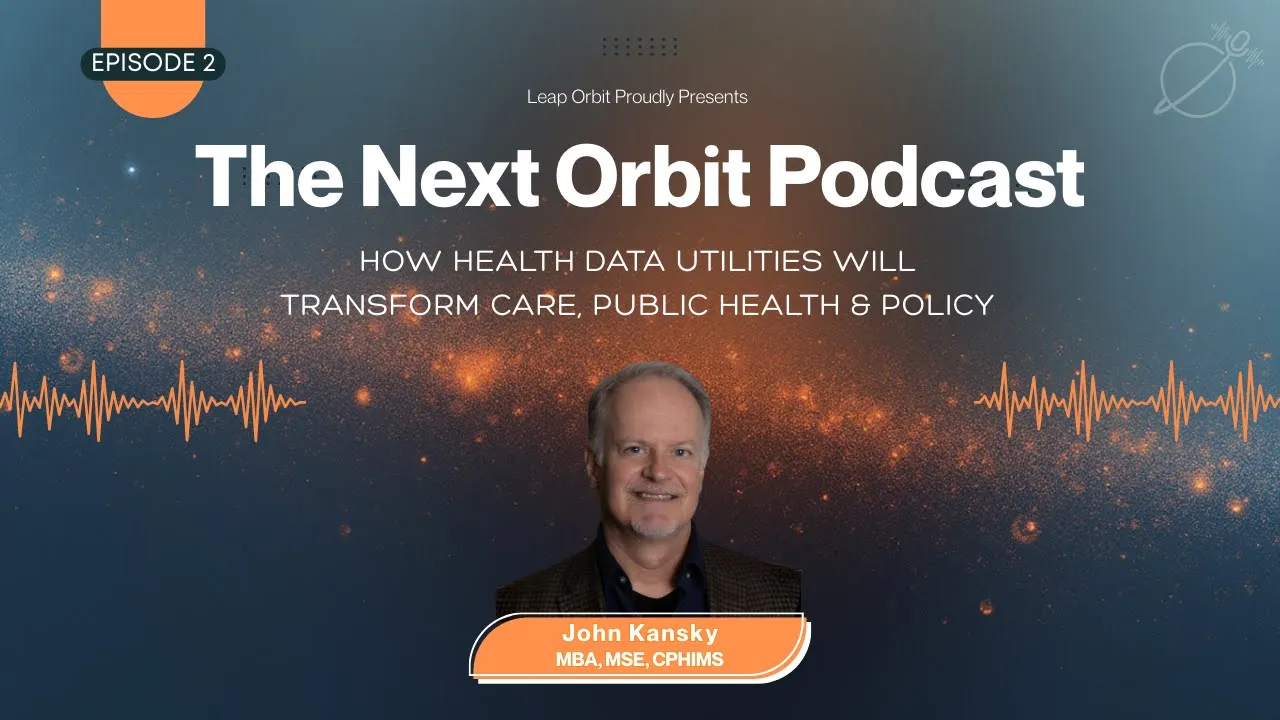
Health data utilities evolve HIEs beyond clinical care to serve state agencies, researchers, and policymakers.

Health information exchanges were built to share data at the point of care. Health data utilities are built to serve everyone who needs health data to do their jobs, from physicians to Medicaid directors to public health epidemiologists. The difference matters, and the gap between the two models is where most states are leaving value on the table.
On a recent episode of the Next Orbit podcast, John Kansky, President and CEO of the Indiana Health Information Exchange (IHIE) and former acting CEO of the Consortium for State and Regional Interoperability (CSRI), walked through what a health data utility is, why it's not a binary designation, and how the new CSRI Capability Model gives states a practical tool to move forward.
CSRI defines a health data utility as "a locally governed, public-private resource providing a source of truth for robust clinical and non-clinical data" that serves the healthcare ecosystem broadly, including providers, payers, public health agencies, researchers, and policymakers.
The distinction from a traditional HIE is scope. Classic health information exchange was focused on getting clinical data to clinicians at the point of care. That remains important. But a health data utility takes the same infrastructure further, making that data available for population health analytics, public health surveillance, academic research, Medicaid program management, and state policy decisions.
Kansky put it plainly on the podcast: "If I'm talking to my state department of health, it's like we get up every morning trying to be the place you guys can go for the data you need, period. So you can be in the public health business, not the 'how do I get data' business."
HDUs aggregate, standardize, and govern data from diverse sources, including clinical providers, public health agencies, and social service organizations, enabling secondary use cases such as population health initiatives, real-time data sharing, and advanced analytics.
The temptation is to treat this as a binary question: is an organization an HDU or not? Kansky's answer is that this framing misses the point entirely.
CSRI's position is that there is little value in using a definition to judge whether Organization A is a health data utility and Organization B is not. The value is in providing an aspirational model for states and health data organizations to plan and measure against.
Every HIE sits somewhere on a continuum. The question worth asking isn't "are we an HDU?" It's "what do we need to build next, and for whom?"
The not-for-profit governance structure and multi-stakeholder accountability are core requirements. So is the ability to serve private sector needs. Kansky flagged an important nuance: state-run HIEs are sometimes legally constrained from charging fees or serving the private sector in ways that would fully qualify them as health data utilities. That's not a disqualifier; it's information for policymakers who want to close the gap.
The CSRI Capability Model defines HDU capabilities in accordance with the unique needs of various healthcare stakeholders, including providers, public health agencies, payers, researchers, and patients.
CSRI released version one as a maturity model in 2023. The 2025 version is called a capability model, and the name change is deliberate. Kansky explained the reasoning directly: "If you're the CDC and you want information on syndromic surveillance, you don't care how mature an organization is. You care how capable it is."
The model assigns each capability a level reflecting graduated sophistication, ranging from Level 1 (Emerging), which covers early-stage operations in planning or pilot phases, to Level 2 (Foundational), which reflects repeatable operations meeting baseline functional requirements.
The model includes gates, foundational capabilities that must be present before an organization can claim a given capability level. Kansky noted that when reviewing these gates, he identified areas where IHIE itself still has work to do. That kind of self-assessment is the point.
For state leaders, the model provides two practical tools. First, organizations that already function as health data utilities can use it to make the case for government recognition and sustained funding. Second, state leaders who want to build or strengthen their HDU can use it to assess existing HIEs and identify investment priorities.
One of the clearest arguments for health data utilities is what happened during COVID-19. When ONC asked whether multiple state HIEs could produce a combined data dashboard, six CSRI member organizations built a multi-state dashboard in three weeks. That pilot grew to 22 states and became the origin story of CSRI itself.
In 2024, a major cyberattack disrupted hospital systems nationwide, including in Indiana, cutting off access to critical patient data for over a month. IHIE stepped in as a real-time clinical data partner, helping maintain care continuity.
The underlying principle is straightforward: data that is already being collected to support clinical care can be reused to support public health, often at marginal additional cost, rather than requiring entirely separate infrastructure. Kansky flagged a recurring pattern where federal agencies fund siloed disease-specific data systems, one for diabetes, one for asthma, and so on, creating redundant cost and fragmented intelligence. A capable health data utility already has much of that data and the infrastructure to analyze it.
A 2025 paper published in the Journal of the American Medical Informatics Association concluded that transforming HIEs into HDUs is essential to realizing the vision of a distributed and connected healthcare data system, and that public funding is critical for this model's success, similar to continued investment in the national highway system.
A common assumption is that clinical data systems prioritize accuracy over speed, and therefore aren't well-suited for public health surveillance. Kansky pushed back on this directly.
Public health agencies frequently make decisions using claims data that is months old, behavioral risk surveys that rely on landline phone calls, or whatever data they can piece together. A functioning health data utility can surface what is happening in near-real time, within hours or days rather than weeks or months.
The challenge is often awareness, not capability. Kansky described conversations with Indiana state legislators and public health leaders who didn't know IHIE existed or that the data they were struggling to find was already available.
"My greatest fear," he said, "is that people are discussing an issue that the health data utility could absolutely be valuable in helping, and nobody in the room knows or thinks of us."
CSRI member organizations collectively connect over 100 million patient records across several states and provide a wide range of services to healthcare organizations and local and statewide health agencies. Despite that scale, funding models vary dramatically and many organizations remain over-reliant on government sources.
Kansky described research he presented with Dr. Julia Adler-Milstein from UCSF showing that among the top 20 health data utility organizations in the country, government funding as a share of total revenue ranged from 2% to 98%. The average, he noted, is a misleading number given that spread.
The principle he advocates is straightforward: organizations that receive value should help cover the cost of producing it. That means providers, payers, health systems, and employers contributing alongside government. A rough working model of thirds, one third from providers, one third from payers, one third from government, has circulated in the industry, though Kansky was candid that no one has fully validated those proportions.
What is clear is that 100% government funding creates fragility, and that states serious about having a capable health data utility should be investing in an organization that can also serve and be compensated by the private sector.
For state agency leaders, the immediate opportunity is to take the capability model seriously as a planning tool. Assess where your existing HIE or HDU sits. Identify which capabilities matter most for your state's near-term needs. Have a conversation about what it would take to close specific gaps and what that investment would unlock.
For HIE and HDU leaders, the capability model is both a roadmap and a communication tool. Use it to show state leaders what you can do, where you're investing, and what you need to move forward.
CSRI and Civitas have established an HDU Steering Council to oversee development and execution of HDU content, advocacy, and model advancement, with the goal that every state should have a statewide health data utility.
The CSRI Capability Model is available at thecsri.org. The comment period Kansky referenced on the podcast has closed, but the model continues to evolve based on industry input.
Leap Orbit works with state agencies, health plans, and healthcare enterprises to modernize the data processes that matter most. Whether you're implementing provider data systems, building interoperability strategies, or assessing health data utility capabilities, our engineering-first approach delivers practical solutions that work in real-world complexity.
What is the difference between an HIE and a health data utility?
A health information exchange primarily supports data sharing for direct patient care. A health data utility builds on that foundation to serve a broader set of stakeholders, including public health agencies, policymakers, researchers, and private sector organizations. The distinction is about scope and governance, not a binary classification.
What is the CSRI Capability Model?
It is a framework developed by the Consortium for State and Regional Interoperability that defines what health data utilities should be capable of, organized by stakeholder type and level of advancement. It is designed to help organizations assess their current state, communicate capabilities to partners and funders, and guide strategic investment.
How are health data utilities funded?
Funding models vary significantly by state. A common working model suggests roughly equal contributions from providers, payers, and government, though actual ratios differ. Organizations that are predominantly government-funded may face limits on their ability to serve the private sector, which can constrain their scope and sustainability.
Why does the capability model use the word "capability" instead of "maturity"?
The term maturity implies a judgment about organizational development. Capability focuses on what an organization can actually deliver for specific stakeholders. The shift reflects a practical orientation: agencies like the CDC don't need to know how mature a health data utility is; they need to know whether it can do what they need.
Can an HIE become a health data utility without starting from scratch?
Yes. In almost every case, an existing HIE is the right foundation to build from. The capability model is designed as a gap analysis tool, not a pass/fail test. Organizations start where they are and identify which capabilities to develop next based on their state's needs and available resources.