Turn daily health data into cases your team can actually act on. Compass is a case management and surveillance platform for public health agencies and regulators, from detection to resolution, with a full audit trail.
What it is
Compass is a case management and surveillance platform for public health agencies and regulators. It ingests prescription monitoring and other health data feeds, applies your own rules to identify what needs review, and manages each case from detection through to correspondence with a complete, immutable record of every action taken.
Replace the spreadsheet-and-email workflow that most public health surveillance and case review programs still run on.
It answers the questions a case reviewer actually has:
Who or what crossed a threshold worth reviewing, and when?
Why was this case opened? Which rule was met, and by which records and values?
Was there a similar case before, and how was it resolved?
Who has viewed, commented on, or changed this case?
What correspondence has gone out, and is it on the record?
By the time a review happens, the risk has often already played out.
Reviews often start long after the events they describe, and review cycles can stretch on for months. Compass shortens that loop. Work from the data feed you already receive, apply rules continuously, and open cases as soon as the data arrives.
Today
With Compass
The problem
Reviews run on stale data, long after the events they describe.
The solution
Rules run continuously against your daily feed, so cases can open as soon as the data arrives, not months later.
The problem
Cases tracked across spreadsheets and inboxes, with no reliable audit trail.
The solution
Every case lives on one dashboard from detection to resolution, and every action is recorded in an immutable audit trail.
The problem
Prior findings aren't surfaced when a related case opens.
The solution
Similar prior cases, with their outcomes and resolution notes, appear inside each new case.
The problem
Hardcoded systems built for one narrow use case, impossible to adapt.
The solution
Your team builds and edits case definitions in the interface, and the same engine extends to new surveillance domains.
Compass takes scheduled daily feeds and ad hoc extracts. Direct database feeds today; CSV and Excel extracts next; FHIR and HL7 support coming soon.
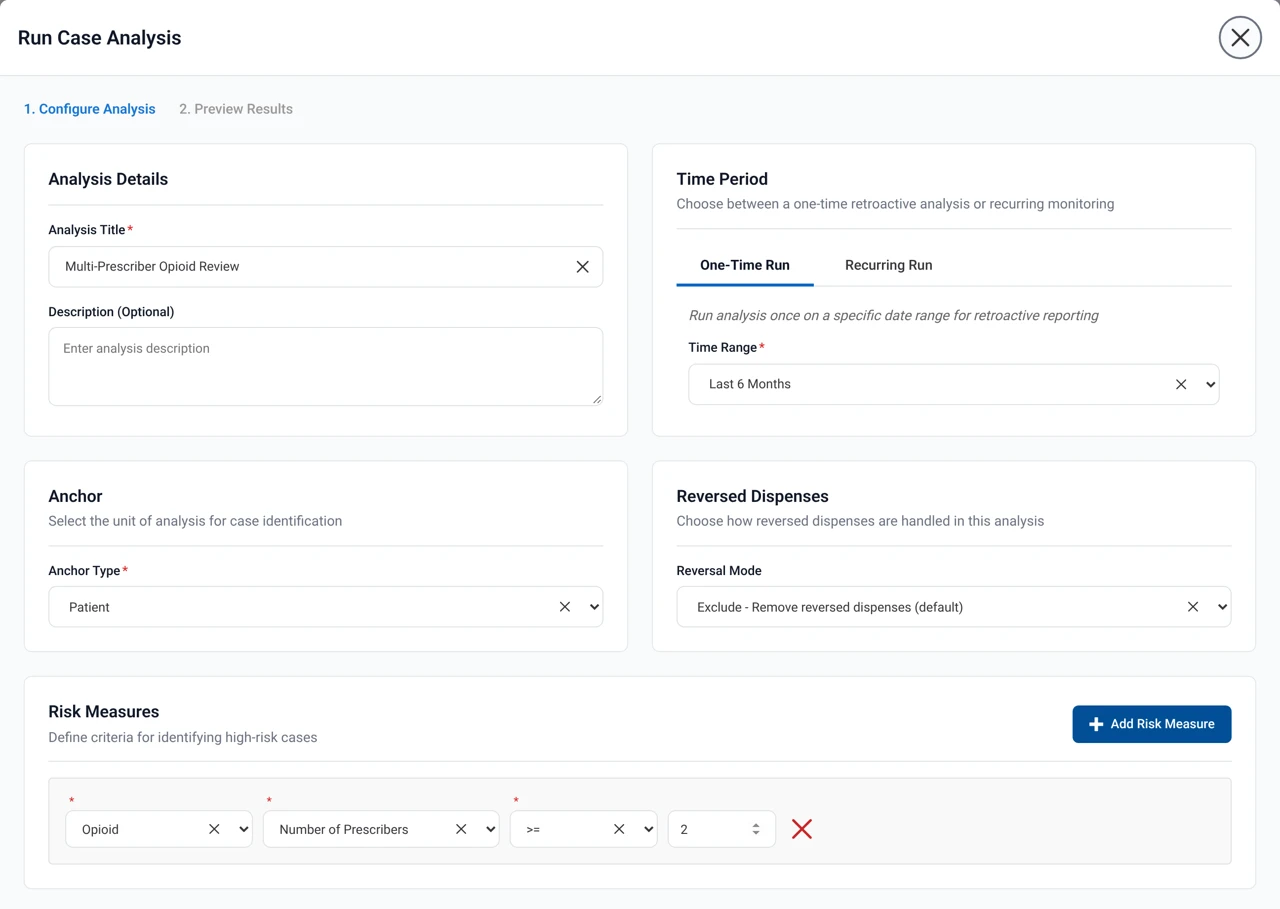
Analysts build case definitions in the interface: the dataset, the rule logic across any available field, thresholds and time windows, exclusions, and notification cadence. If the field is in your data, you can write a rule against it.

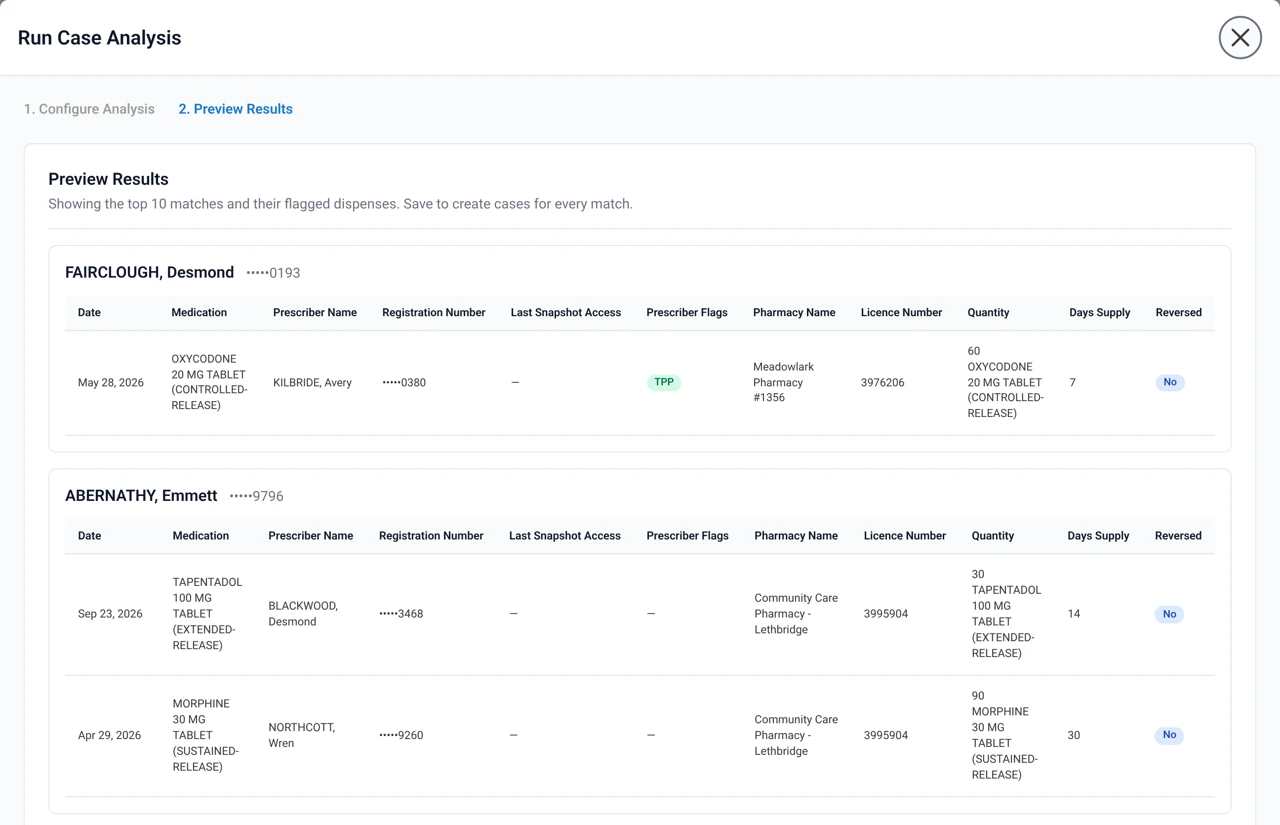
Every definition can be previewed against live data before it's saved; you see both sample matching records and the projected case volume, so you can tune a threshold to the caseload your team can genuinely absorb rather than discovering the backlog afterwards.

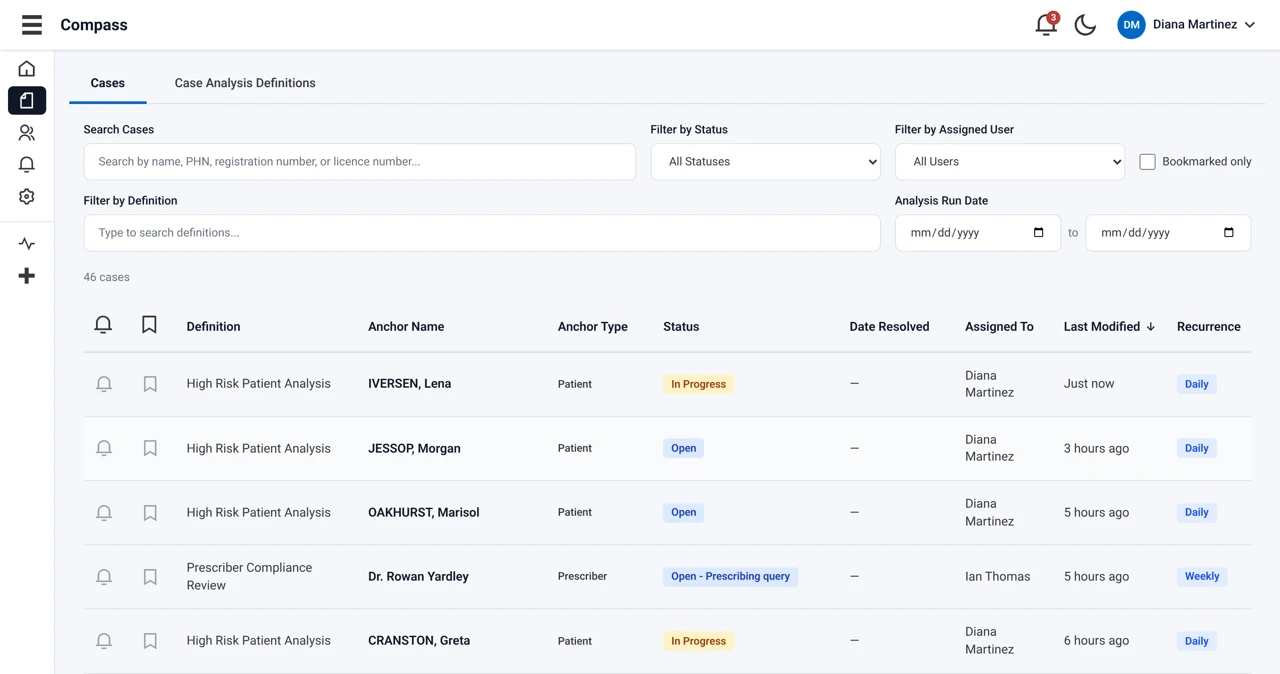
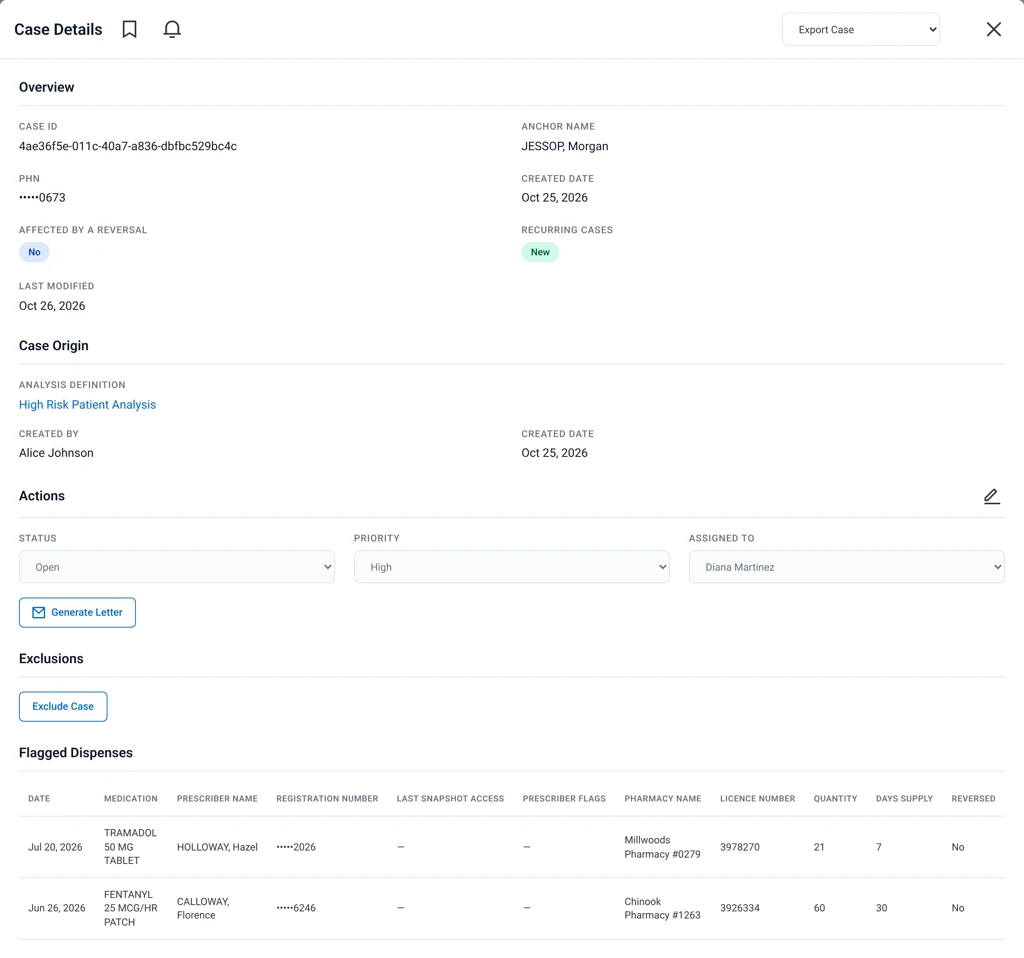
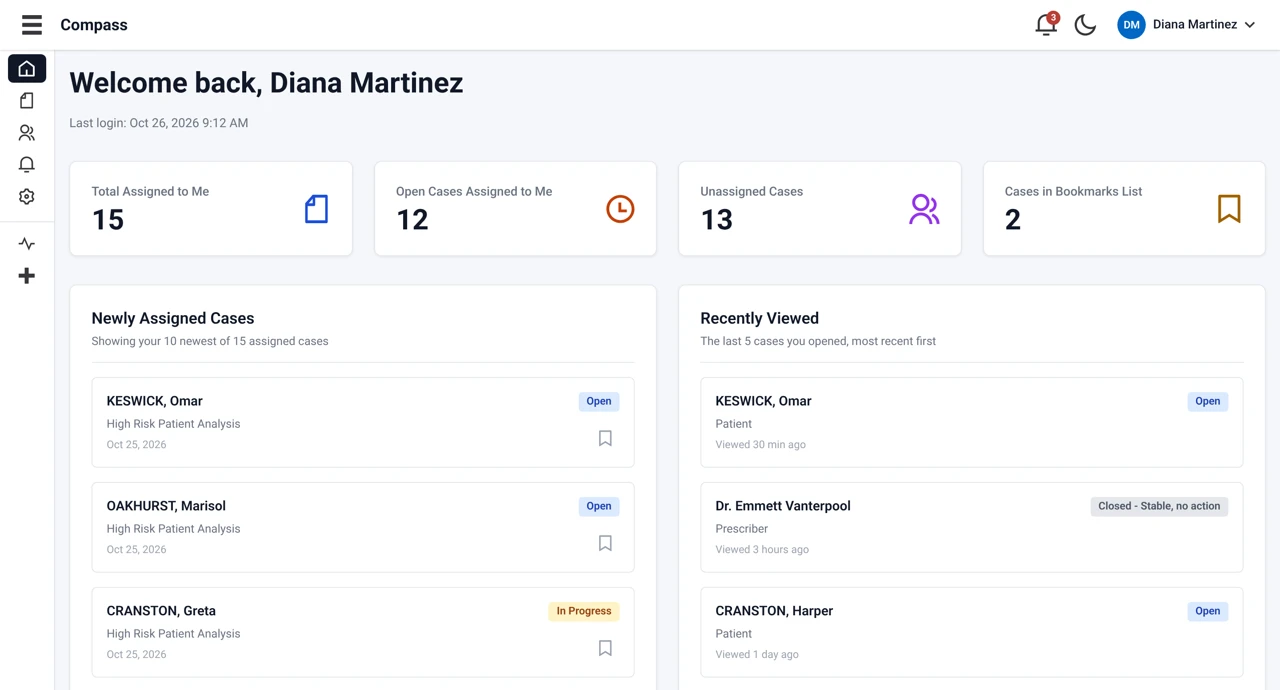
Cases arrive on a dashboard with assignment, status, comments, and analytics in one place. Similar prior cases surface inside the case, with their outcomes and resolution notes, so nobody re-investigates ground already covered.


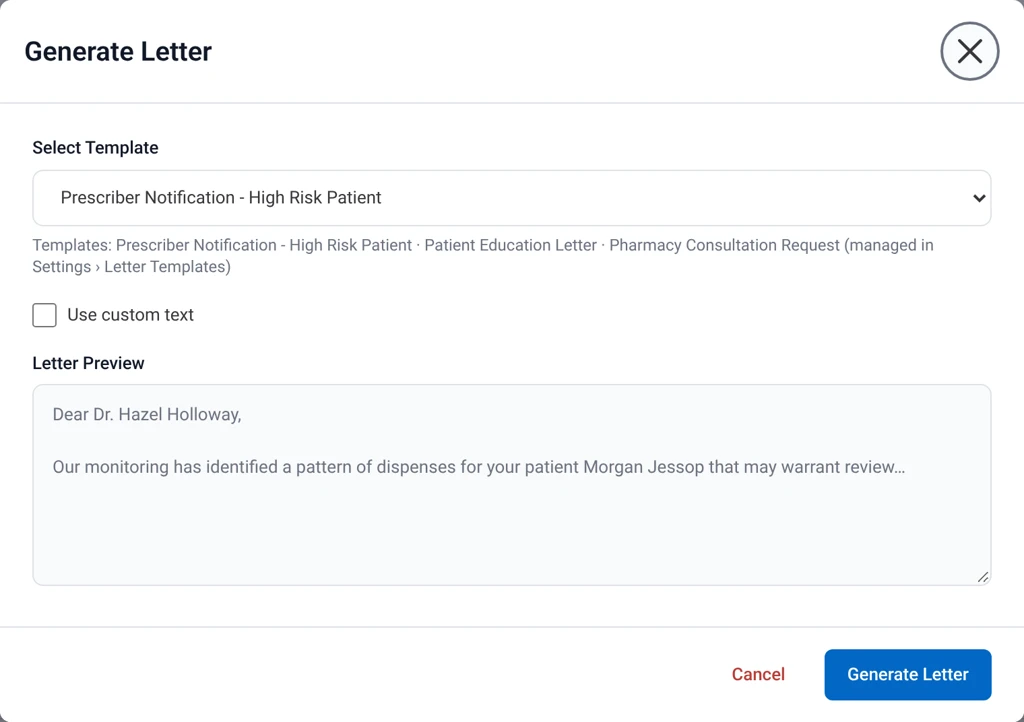
Generate correspondence from approved templates with validated dynamic fields, export to Word or PDF, and keep the generated document attached to the case rather than sitting in someone's sent items.

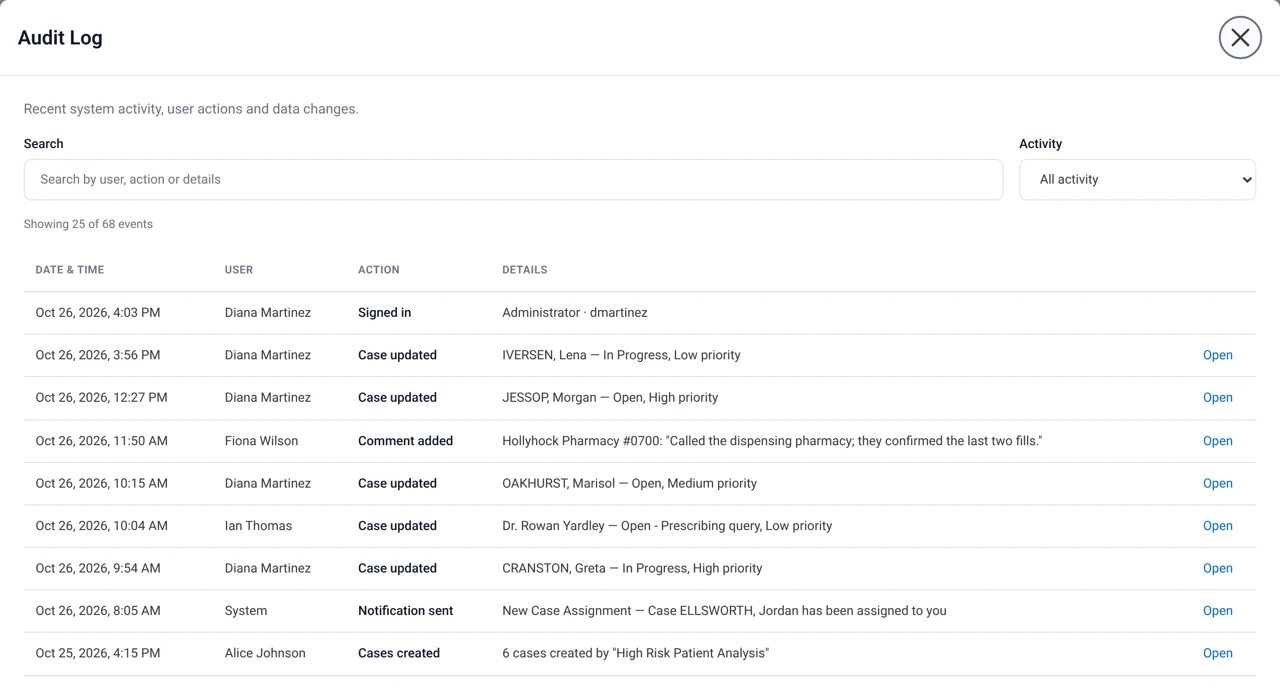
Every view, comment, status change, definition change, export, and share is recorded immutably and is searchable by user, action, entity, and timeframe.

Compass is a domain-agnostic signal-to-case engine with modules on top, rather than a prescription-monitoring tool with hooks bolted on.
Current Use Cases
One engine
The same engine is designed to extend to other public health surveillance domains, such as water quality testing or food-borne illness outbreaks.
Rule sets for OME/MME, DDD, days' supply, multi-prescriber, multi-pharmacy, multi-drug, drug class, and controlled substances.
Rules on prescribing restrictions and practitioner–patient interaction conditions.
Shared, managed lists so known-legitimate cohorts stay off case lists.
Shared, versioned correspondence templates.
Multi-factor authentication, encryption in transit and at rest, least-privilege access.
Immutable audit trail across all actions, with exportable logs for reporting and review.
Data residency in the region your privacy legislation requires.
Screenshots, demos, and training use a synthetic dataset.
Common questions about Compass.
A configurable case management and surveillance platform. It ingests health data feeds, identifies what needs review using rules you define, and manages each case through to resolution with a full audit trail.
Public health agencies and regulatory bodies: case managers and analysts doing the reviews, program administrators setting the rules and watching the volumes, and medical advisors making the clinical calls.
No. Compass works from the data your monitoring program produces. It's the review and case layer, not the collection layer.
Compass identifies what needs review and manages each case through to resolution. Insights is where your team explores the data behind it, with or without a case open. Soon, you'll be able to open the matching Insights profile directly from a Compass case.
Your team. Definitions are built and edited in the interface, previewed against live data, and their creation and modification is captured in the audit log.
Cases can open as soon as the data comes in, depending on your feed cadence and any hold-off period you configure.
Records can be reversed or corrected after submission. Compass applies a configurable hold-off period before a record becomes eligible for case analysis, which cuts down on cases opened against records that are later withdrawn.
Yes. Exclusion lists are managed by your team and can be applied to any case definition.
Database feeds today, with CSV and Excel extracts and standards-based feeds (FHIR, HL7) phased in.
Turn the data feed you already receive into cases your team can review, act on and audit, with rules your own analysts control.